Relay announced on Thursday that it is shutting down.
Free users have until August 15, 2026. Paying customers have until September 14. Existing workflows will keep running during the wind-down period, and Relay has provided ways to export the underlying data.
That helps with the immediate problem.
It does not solve the uncomfortable one.
Relay was one of the best no-code automation tools on the market. It was simple, thoughtful, unusually good at AI integrations and backed by a team that shipped fast.
Three months ago, using it still made complete sense.
Now it is disappearing.
The obvious lesson is that you should not depend too heavily on one platform.
I think the bigger lesson is more uncomfortable:
The original premise of no-code automation no longer holds.
This did not start with Relay
At the beginning of 2026, I set myself a challenge: stop building our internal automations with no-code tools.
Not because they had suddenly stopped working.
I wanted to understand how far AI-assisted development had really come.
Could someone like me—a non-developer who had built a career around Notion and no-code automation—replace the visual workflow builders with actual code?
The answer turned out to be yes.
Not perfectly. Not magically. And definitely not by opening Claude Code once and typing “build my business system.”
But consistently enough that the old default started to look increasingly difficult to justify.
Relay survived as an occasional exception because it was genuinely quick and convenient for small helpers. Ironically, it was often faster to build something in Relay than in n8n or Make.
For anything that needed to become part of our operational infrastructure, though, code was already winning.
Then Notion Workers arrived.
While preparing a workshop about them, I kept asking myself:
Why would I use a Notion Worker when I can already build this in Make?
And then it hit me.
I had the question backwards.
Why would I build this in Make when AI can help me create the actual code?
That was the catalyst for moving the same principle into our client work.
For new client infrastructure, code is now our default. We still use no-code occasionally for disposable or genuinely faster small helpers—but no longer as the foundation of an operational system.
Relay shutting down did not create that decision is only the next sign in this series of changes.
The bargain no-code automation offered
No-code automation tools gave us an incredibly attractive bargain.
You did not need to understand APIs, OAuth, cron jobs, servers, deployment, logging or error handling before you could connect two tools and remove hours of manual work.
You opened a visual builder.
Connected your accounts.
Dragged a few modules onto a canvas.
And shipped the workflow before a traditional developer had finished writing the estimate.
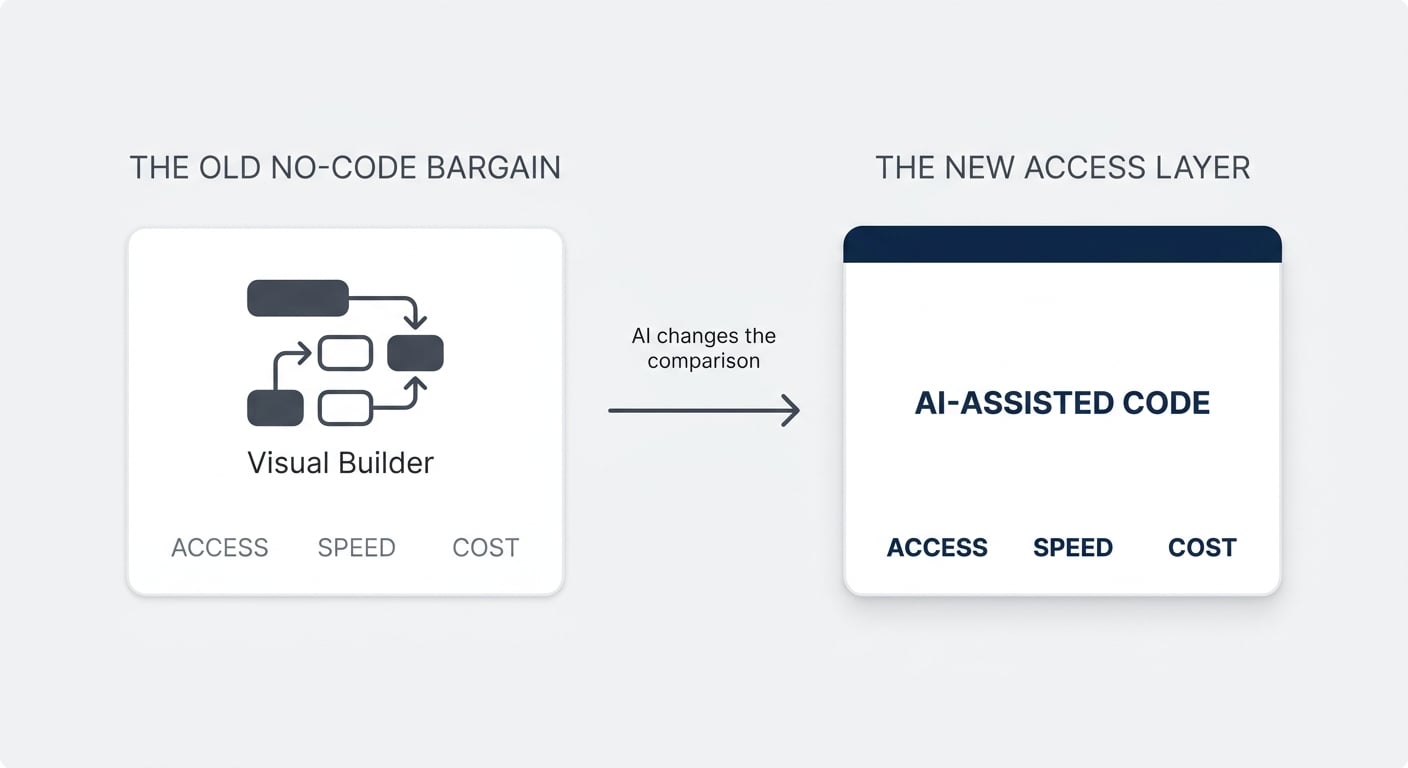
No-code used to win on three things:
- Access — non-engineers could finally build integrations themselves.
- Speed — small workflows could be shipped in hours rather than weeks.
- Cost — automating a minor internal process became economically viable.
That last part mattered more than most people realised.
No-code did not merely make existing software cheaper to build. It changed what was worth building at all.
The annoying weekly handoff became worth fixing.
The 15-minute admin task became worth removing.
The small internal workflow no engineering team would ever prioritise became possible.
I built a large part of my career on that shift.
No-code gave a non-developer access to APIs, automation and systems thinking. It helped me connect Notion to the rest of a company’s tool stack and eventually build a consultancy around that work.
AI broke the original value proposition
The old alternative to no-code was custom software.
And custom software meant developers, specifications, servers, deployments, long timelines and a budget that made no sense for most internal workflows.
That comparison made the visual canvas an obvious winner.
But that is no longer the comparison.
Today, an operator who understands a workflow can describe the requirements to an AI coding agent, pressure-test the edge cases and generate the first implementation in less time than it takes to click through a complex no-code canvas.
The more complex the workflow becomes, the stronger that advantage gets.
Changing a requirement in code can mean describing the new behaviour and reviewing the diff.
Changing it in a visual builder can mean opening ten modules, remapping fields and checking every branch manually.
No-code once made software accessible.
AI is becoming the new access layer.
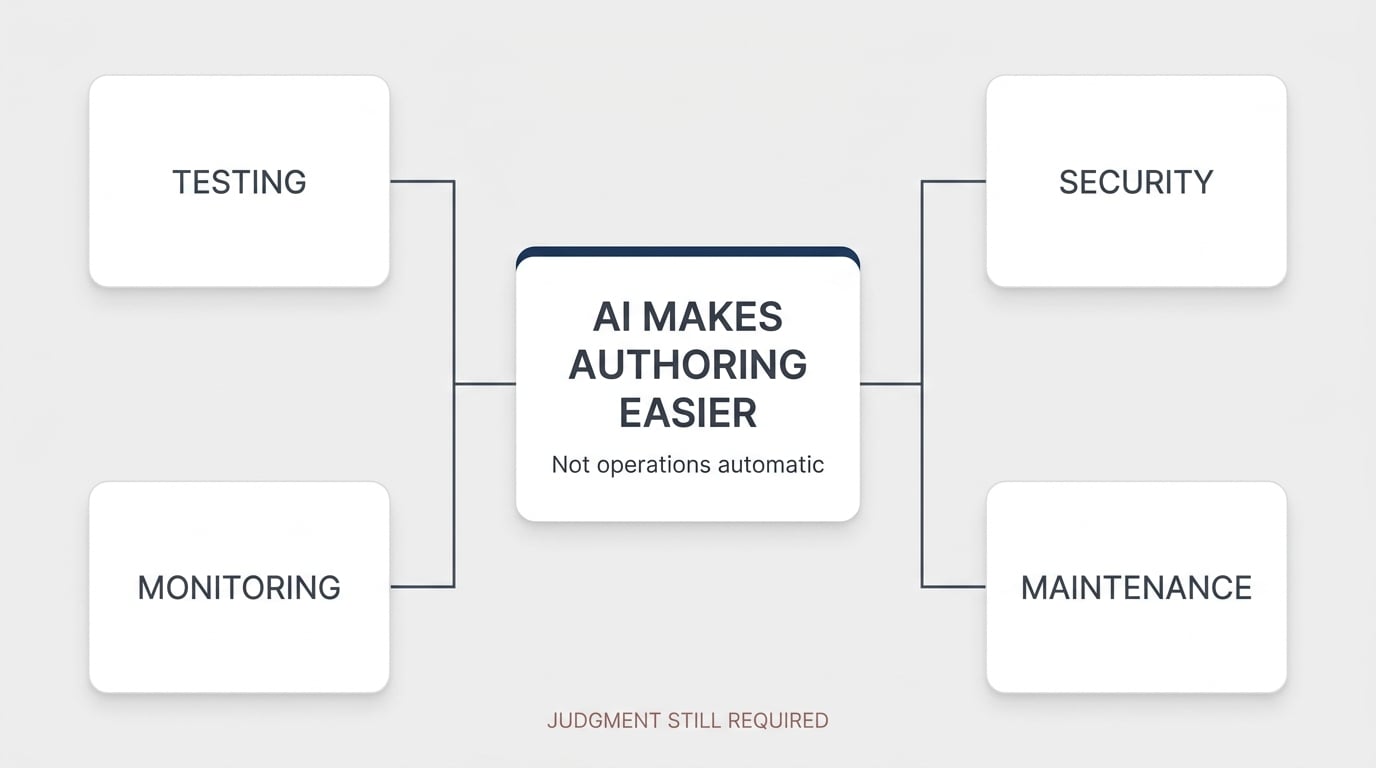
That does not mean reliable software is suddenly easy.
AI has made authoring dramatically easier. It has not removed the need for judgment, testing, security, monitoring, maintenance or a clear understanding of what the system is supposed to do.
This distinction matters.
The argument is not that anyone can vibe-code a critical business system on Friday afternoon and forget about it.
The argument is that manually assembling business logic inside a proprietary visual canvas is no longer the most efficient way to express that logic.
The visual canvas can no longer justify the product
This is where Make and n8n face a much bigger problem than one competitor shutting down.
Unless they reinvent what their products are for, their current visual-building model is heading toward irrelevance.
There’s simply not enough of a value proposition for serious builders using them at the moment.
A more plausible future looks different:
- You describe the workflow in natural language.
- The system turns that description into code or another portable representation.
- The canvas visualises the process, dependencies and failures.
- The platform handles authentication, deployment, retries, logs and monitoring.
- Humans use the visual layer to understand and debug the system—not to configure every calculation manually.
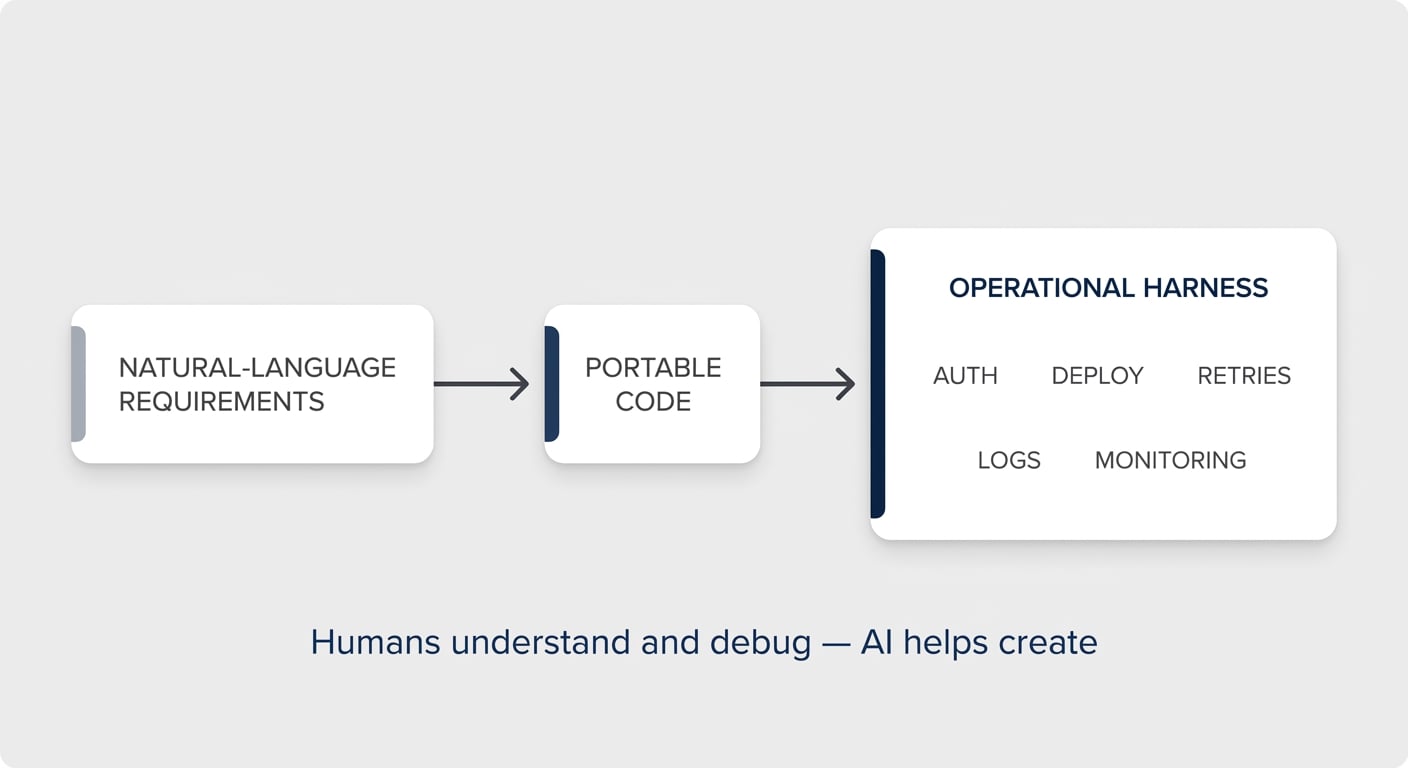
In that future, the valuable product is not a drag-and-drop code replacement.
It is an operational harness around software that AI helps you create.
There are still things these platforms can offer.
Managed authentication is valuable. Reliable retries are valuable. Governance and observability are valuable. A library of difficult API connectors is valuable—particularly for closed platforms where access is painful to implement yourself.
But those are very different reasons to buy the product.
The original pitch was: you do not need code.
The next pitch may need to be: we make AI-generated software safe and manageable.
If they manage that pivot and can make a clear case for themselves, I’m happy to go back.
But at the moment, they lose on pretty much every metric.
The durable skill was never knowing where to click
If you have spent years building workflows in Relay, Make or n8n, this is not an argument that your knowledge is worthless.
Quite the opposite.
You have already learned much of the difficult conceptual work:
- What triggers the workflow?
- What data does it need?
- Which system owns that data?
- What happens when a field is missing?
- Which exceptions exist in the business logic?
- What should happen when an API fails?
- Who needs to know when something breaks?
That is systems literacy.
It transfers across tools.
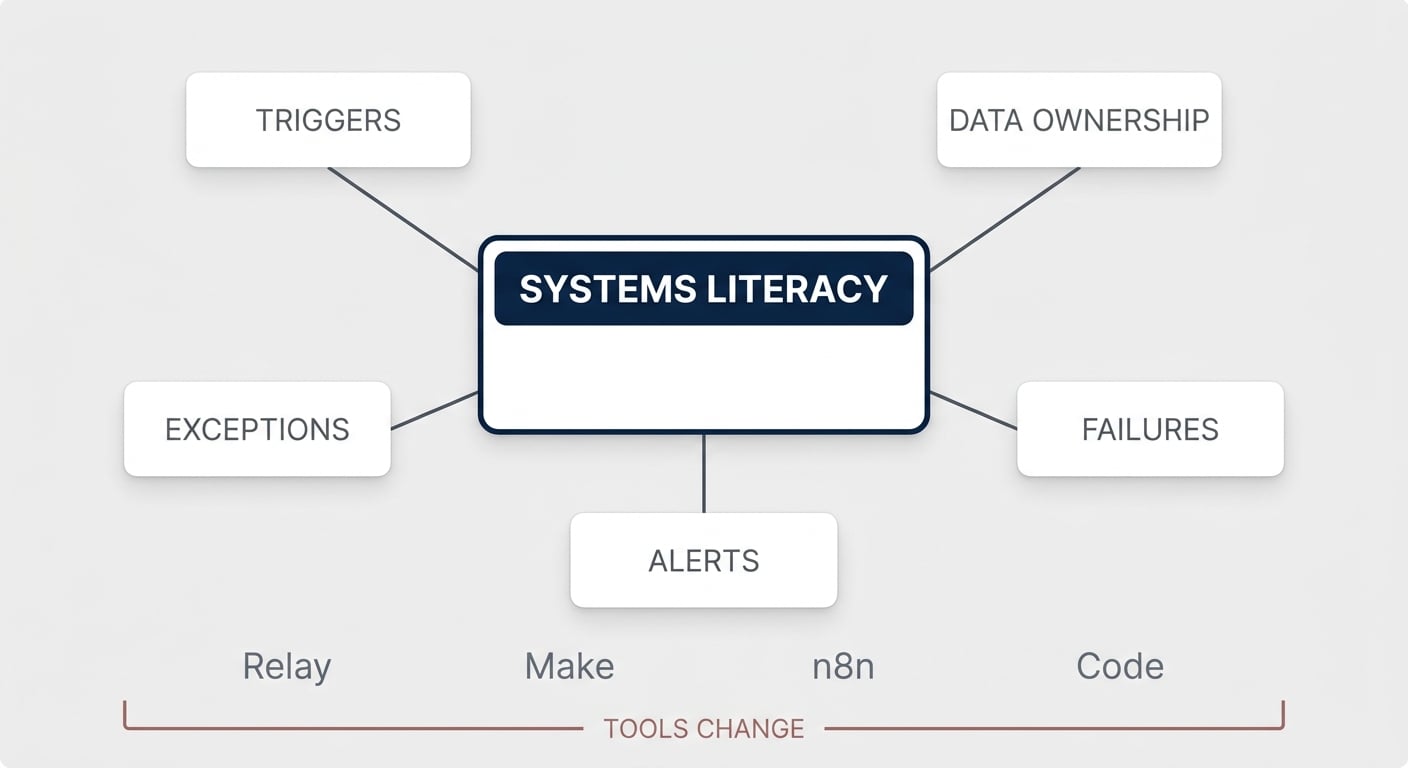
Knowing exactly where to click in one platform does not.
The durable asset was never the workflow canvas. It was your understanding of the process represented on it.
AI makes that understanding more valuable because it lets operators express it in a more flexible form.
What we build instead
Our new client systems generally have two homes.
When the logic should live directly inside Notion, we use Notion Workers: small TypeScript programmes hosted by Notion that can receive webhooks, synchronise external data or become tools for custom agents.
For infrastructure that needs more control, longer-running processes or services outside Notion’s boundaries, we deploy custom code on managed Hetzner infrastructure.
There is a fun full-circle element to that: Hetzner is also a client of ours. We once helped their teams build better operational systems in Notion; now their infrastructure helps us run the next generation of systems we build for other clients.
We can choose the right runtime for the job.
We can keep the implementation in version control.
We can test it, document it, move it and let AI help maintain it.
The tool becomes a deployment decision—not the skill itself.
So, is no-code automation dead?
Not tomorrow.
There will be a transition period. Existing workflows will continue to run. Teams will keep using tools they already understand. Many simple automations will not be worth rebuilding just because a newer approach exists.
And some no-code companies may reinvent themselves quickly enough to become the AI-first operational layer described above.
But the era of no-code automation as the default access layer for non-technical builders is ending.
Its original advantages—access, speed and cost—are being eroded by AI-assisted development.
The platforms may survive.
The old value proposition will not.
If you are an operator, the answer is not to panic and pick the next canvas.
Learn to describe systems clearly. Learn how APIs, authentication and failure handling work at a conceptual level. Learn to direct an AI coding agent, review what it produces and recognise where the dangerous edges are.
You do not need to become a traditional software engineer.
But you should become someone who understands a workflow well enough to rebuild it when the platform layer changes.
Because Relay will not be the last tool to disappear.
If you want to practise that shift in a concrete environment, start with our complete beginner’s guide to Notion Workers. It walks you through three different worker types and lets you ship real automations without writing the code by hand.
If the challenge is not just building one workflow but helping a whole team understand where AI belongs, our Notion AI Essentials training covers the frameworks, shared context and reusable skills behind that transition.
And if you want to move beyond isolated experiments and build a reliable operating system around Notion, AI and custom infrastructure, that is exactly what we do through our Notion consulting services.