Alva Labs had everything you’d want for an AI-ready company. A tech-forward team in Stockholm. A CEO already building custom AI workflows on the side. An internal architect pushing for organization-wide adoption.
But before they took the moonshot, they first had to build out the foundation.
We ran an 8-week transformation sprint with Alva — and the most important decision we made was what not to build. Instead of the exciting AI projects that came up early in discovery, we went straight for the plumbing: a three-pillar operating system, a dashboard architecture that separates data from interface, and an AI configuration that gives the models something real to work with.
Here’s why the counterintuitive decision to NOT build AI first if you want to become an AI-native company makes a lot of sense.
Alva Labs is one of Europe’s most trusted psychometric assessment providers, now building the AI Hiring System — one connected system that replaces the disconnected tools most talent teams run today.
Founded in 2017, headquartered in Stockholm. Around 60 people. Close to $20M raised, including a Series A led by VNV Global. Trusted by 650+ organisations, including enterprise talent teams at SEB, Instabee, Mentimeter, Tre and Tele2.
Their system covers the full hiring journey — from defining what great looks like, through science-backed assessments and structured interviews, to confident, evidence-based decisions. Not another tool in the stack. The system that replaces it.
The platform combines DNV-certified psychometric assessments with structured interview frameworks, coding tests, and AI-powered role-fit scoring. Alva holds a rare triple certification: ISO/IEC 42001 for responsible AI, ISO 27001 for information security, and ISO 10667-2 for assessment methodology — making it one of the most rigorously certified hiring systems in the world. Their AI is transparent, fair, and auditable by design.
The brand promise is straightforward: accurate hiring made easy.
A company that ships responsible AI products and genuinely lives the “move fast” culture. When we started the project, the energy was immediately obvious — from the CEO down to individual team members, people were curious, building things, and pushing boundaries with AI.
That enthusiasm is rare. Our job was to give it the right infrastructure to scale.
The Challenge
When a company grows quickly and the team is full of builders, Notion workspaces tend to evolve organically. People create solutions for their own needs. New tools get adopted. Things move fast.
At some point — usually around the 40- to 50-person mark — that organic growth starts to create friction.
Not because anyone made a mistake.
Because the tools haven’t kept pace with how fast the company has moved.
That’s exactly where Alva was when we started.
We ran our two-week blueprint audit as part of our signature process and identified three areas where investing in structure would pay off immediately.
1. The Graveyard Problem
Like most scaling companies, Alva had built up a significant body of documentation over the years.
The challenge?
Parts of it had gone stale, and there was no easy way to tell which pages were current and which weren’t.
One team lead walked us through a great example: two pages at the top of the CS space that the team used daily — and a larger collection below that had served its purpose but hadn’t been updated in a while.
Without that context from him, you couldn’t distinguish the two.
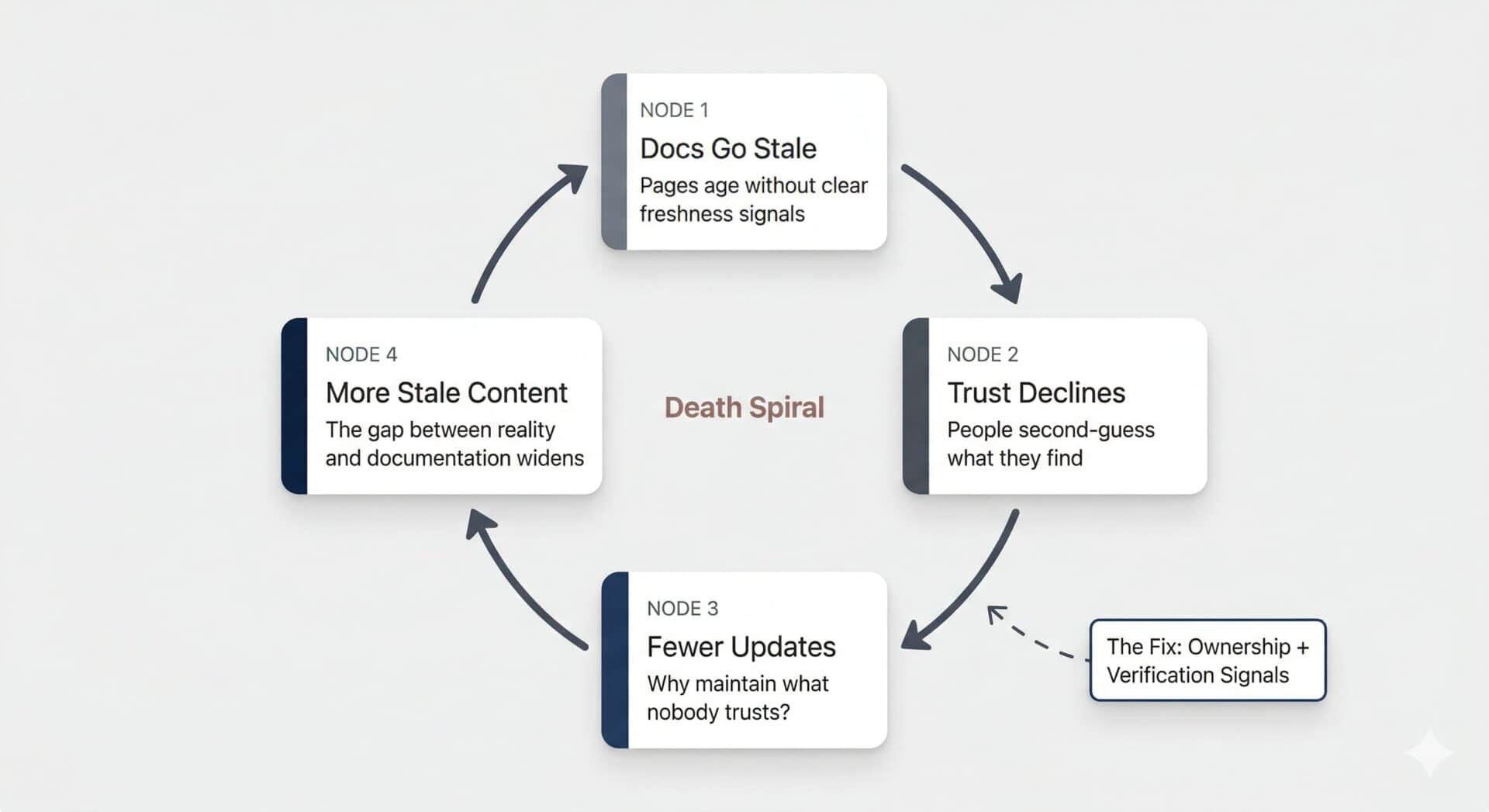
This is a pattern we see everywhere. We call it the trust-update death spiral. When documentation ages without clear freshness signals, people start second-guessing what they find. That means fewer updates. Which means more stale content. And so on.
The fix isn’t more documentation. It’s better signals — ownership, verification, and a system that naturally surfaces what’s current.
2. Single Player × Tool Sprawl
Alva’s team is full of proactive people who take initiative. The flip side? Several teams had independently built their own tracking systems, OKR trackers, and workflows — all solid individually, but disconnected from each other.
Three meeting transcription tools were running in parallel (Gong for CS/Sales, Fathom, and Notion). OKR tracking lived in different places depending on who you asked. Knowledge was spread across shared spaces and private pages.
None of this is unusual for a company at Alva’s stage. It’s a natural result of a team that moves fast and solves problems as they come up. The opportunity was to consolidate — give everyone a shared system while preserving the flexibility that makes them productive.
3. The Floor Is Too Low
This was the most interesting finding. Everyone at Alva was excited about AI. Malcolm was already building custom workflows with Claude and Obsidian. Max was pushing an AI strategy across the organization.
But across the interviews, we kept hearing a version of the same observation: Notion AI didn’t feel as powerful as standalone tools like ChatGPT.
Notion AI uses the same underlying models. When configured well, it should outperform standalone tools for knowledge work — because it has access to your company’s context. But that’s exactly the point: Alva hadn’t yet set up the system prompt, verification signals, and structured context that would let the AI do its best work.
The models were capable. The context layer hadn’t been built yet.
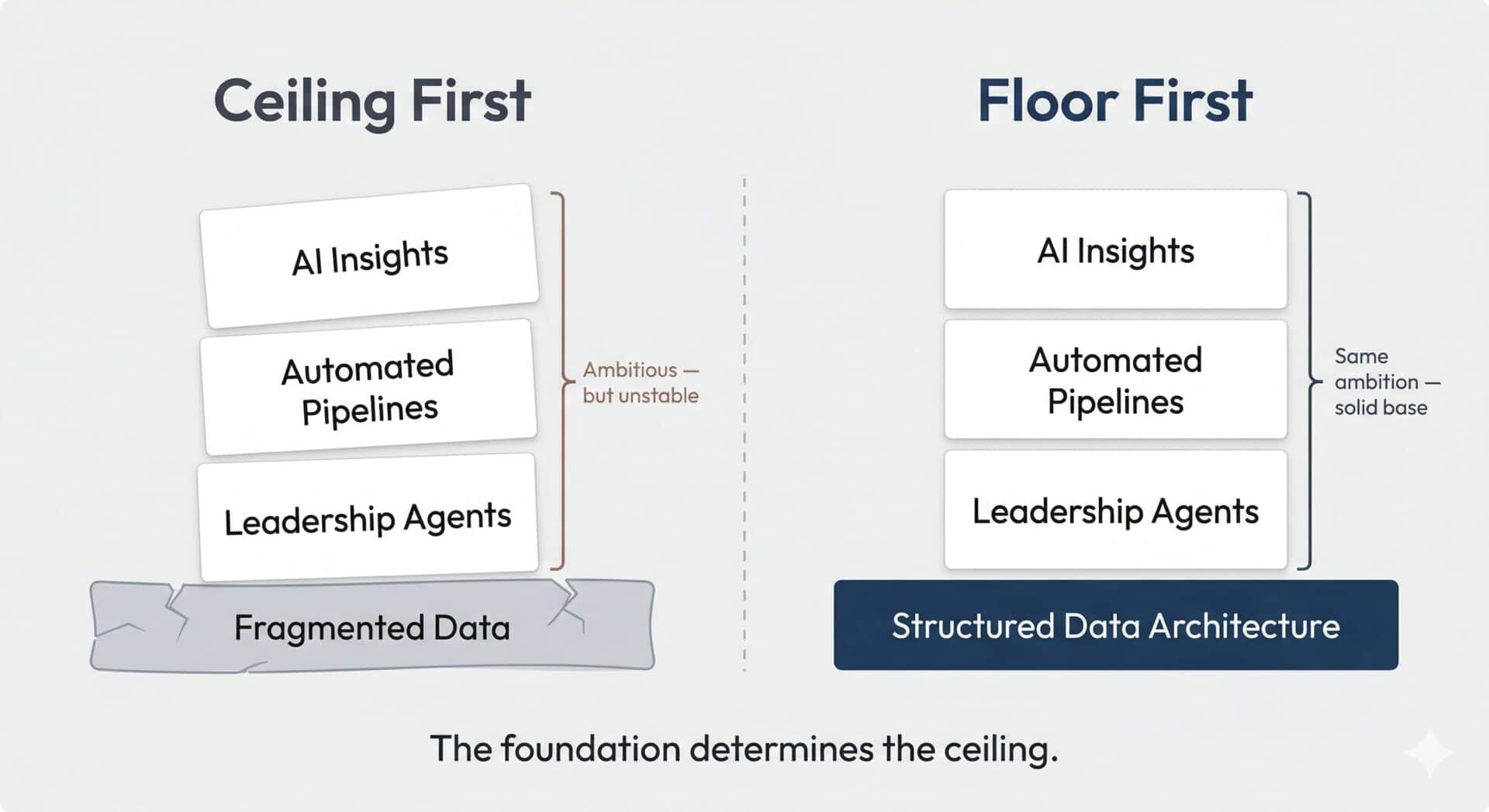
This is the pattern we see at nearly every company we work with. Leadership is excited about ambitious AI projects — agents, automated insights, intelligent pipelines. But those projects all need a solid data foundation underneath them. Build the floor first. Then raise the ceiling.
The Strategic Call
Max and Malcolm came to us with ambitious ideas. Intercom pipelines. Leadership agents. Automated customer insights. All projects we’d love to build.
Our recommendation: start with the foundation.
Every one of those projects required a data architecture that wasn’t in place yet. And investing in the floor for the full organization would create more total impact than jumping straight to advanced projects for a few power users.
Max framed it well: “Notion will be the floor, and then Claude Code will be the ceiling.”
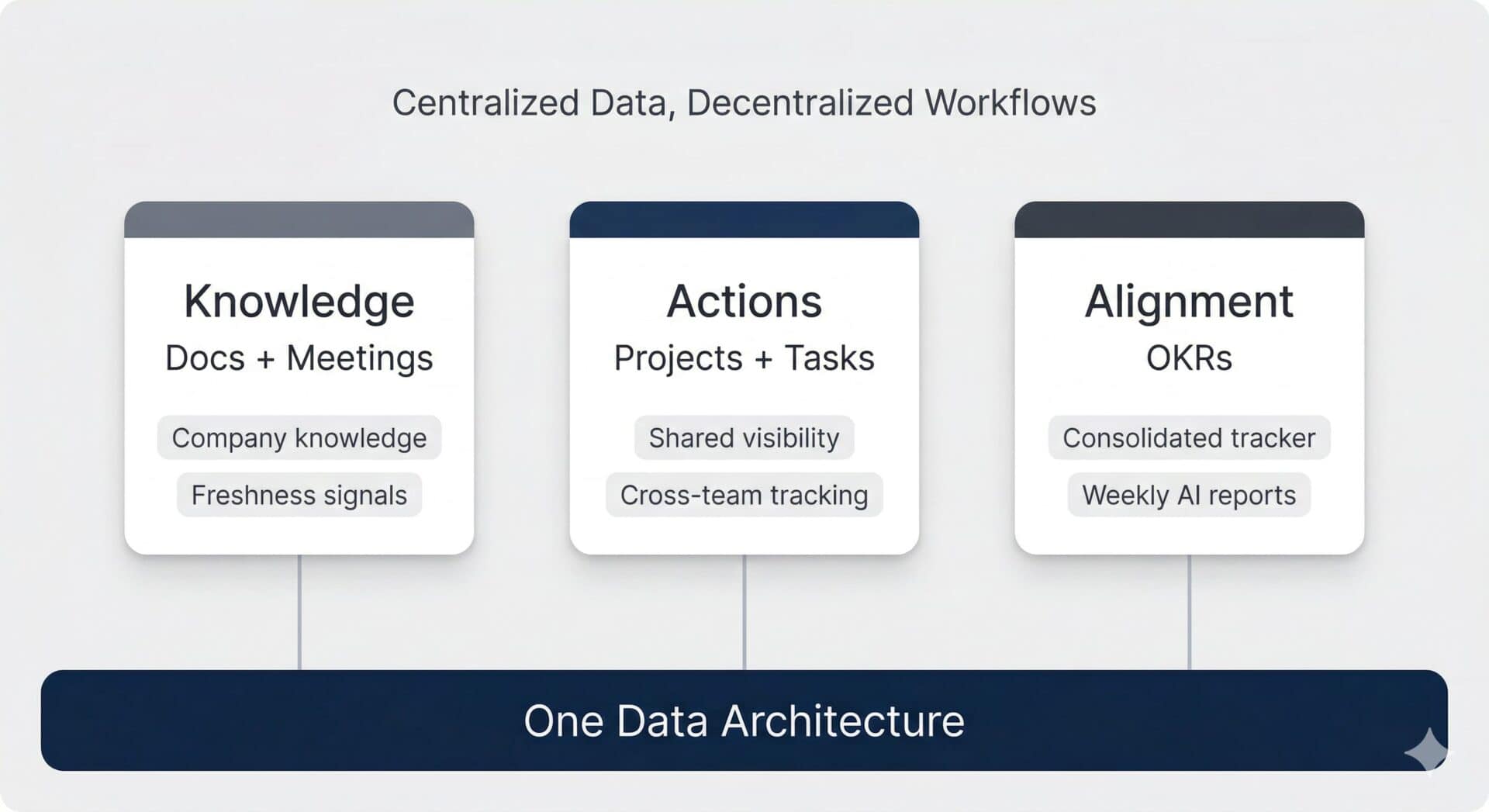
Knowledge (Docs + Meetings) — every piece of company knowledge in one system. Ownership, verification, and one simple rule: if you create a page, it goes in Docs. Clear freshness signals so everyone — humans and AI — can tell what’s current.
Actions (Projects + Tasks) — a shared visibility layer for project management across the company. For the first time, anyone can answer: “What is that team working on?”
Alignment (OKRs) — one consolidated tracker bringing together the different versions teams had built. Structured for AI analysis. Weekly reports that preserve context over time instead of overwriting it.
Centralized Data, Decentralized Workflows. One data architecture, many interfaces. Databases are standardized and locked. How each person interacts with them? Entirely up to them.
2. Dashboards as Frontend
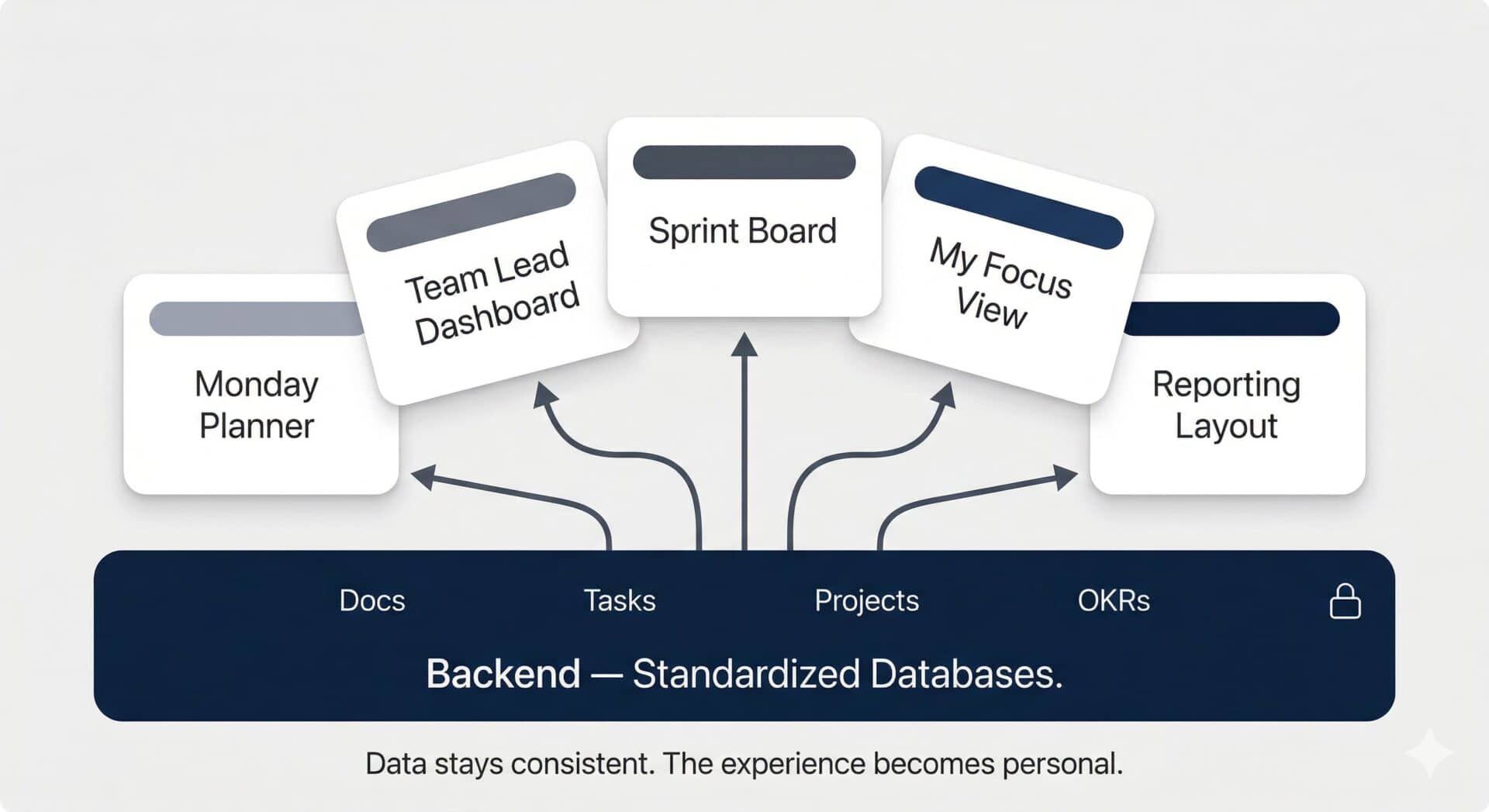
Databases are the backend. That’s where data lives — standardized, consistent. Dashboards are the frontend. That’s how people actually interact with it.
We built defaults that work out of the box — what we call Building Blocks, Not Blank Pages. New team members get them automatically. Champions and power users build their own — showing exactly what they need. Nothing else.
Monday morning dashboard with this week’s tasks and yesterday’s meeting notes? Build it. Prefer a timeline over a Kanban board? Switch it. Want the reporting layout your team lead designed? Subscribe to it.
Data stays consistent. The experience becomes personal.
Max connected this to his Obsidian setup immediately: “The thought I get is to migrate my Obsidian structure into my own custom dashboard. Adapted to how I do things.”
3. AI-Ready From Day One
Everything we built was designed around one question: can AI work with this?
A master prompt with company context and instructions to prioritize verified information. 90-day verification cycles that create trust signals for humans and AI.
The Campsite Principle — no forced bulk migration. We instructed AI to prioritize verified docs in the central system, so information rises in relevance organically as people use it.
A meeting-to-action workflow where AI processes transcripts and creates follow-up tasks.
Malcolm noticed the impact before the databases were even fully populated:
“It feels like Notion is already performing a lot better for me — even though there’s barely any context in those databases yet.”
Small structural improvements — the right model, a proper system prompt, clear context signals — compound fast. Malcolm saw it:
“This project really shed the light on the compounding effect. I prepped a presentation — super fast drawing out the outline in Notion, took that to my AI, did it one shot, no tweaks. Probably saved one or two hours. And then my cofounder took the same skill and did a presentation in five minutes.”
Two people. One skill. Instant multiplication. That’s what a properly built floor makes possible.
What’s Next For Alva
Whenever we run a project we have one goal:
We want to replace ourselves.
Education and ownership is at the center of everything we do. You should be able to run the systems we build on your own.
But if you want to keep us at your side, we’re of course thrilled to be your long-term strategic partner for all things Notion and AI.
Max’s verdict:
“10 out of 10. You are not only this Notion expert, but also someone that is pushing in general how you work with AI — building your own systems, thinking in terms of how we can build these systems. That is helping us at Alva so much. That is what we are looking for in a partner.”
With Phase 1 in the books, we’re now looking to bring Notion AI even deeper into the organisation.
To provide the best experiences, we use technologies like cookies to store and/or access device information. Consenting to these technologies will allow us to process data such as browsing behavior or unique IDs on this site. Not consenting or withdrawing consent, may adversely affect certain features and functions. You can find the Privacy Policy here.
Functional
Always active
The technical storage or access is strictly necessary for the legitimate purpose of enabling the use of a specific service explicitly requested by the subscriber or user, or for the sole purpose of carrying out the transmission of a communication over an electronic communications network.
Preferences
The technical storage or access is necessary for the legitimate purpose of storing preferences that are not requested by the subscriber or user.
Statistics
The technical storage or access that is used exclusively for statistical purposes.The technical storage or access that is used exclusively for anonymous statistical purposes. Without a subpoena, voluntary compliance on the part of your Internet Service Provider, or additional records from a third party, information stored or retrieved for this purpose alone cannot usually be used to identify you.
Marketing
The technical storage or access is required to create user profiles to send advertising, or to track the user on a website or across several websites for similar marketing purposes.
To provide the best experiences, we use technologies like cookies to store and/or access device information. Consenting to these technologies will allow us to process data such as browsing behavior or unique IDs on this site. Not consenting or withdrawing consent, may adversely affect certain features and functions.
Functional
Always active
The technical storage or access is strictly necessary for the legitimate purpose of enabling the use of a specific service explicitly requested by the subscriber or user, or for the sole purpose of carrying out the transmission of a communication over an electronic communications network.
Preferences
The technical storage or access is necessary for the legitimate purpose of storing preferences that are not requested by the subscriber or user.
Statistics
The technical storage or access that is used exclusively for statistical purposes.The technical storage or access that is used exclusively for anonymous statistical purposes. Without a subpoena, voluntary compliance on the part of your Internet Service Provider, or additional records from a third party, information stored or retrieved for this purpose alone cannot usually be used to identify you.
Marketing
The technical storage or access is required to create user profiles to send advertising, or to track the user on a website or across several websites for similar marketing purposes.